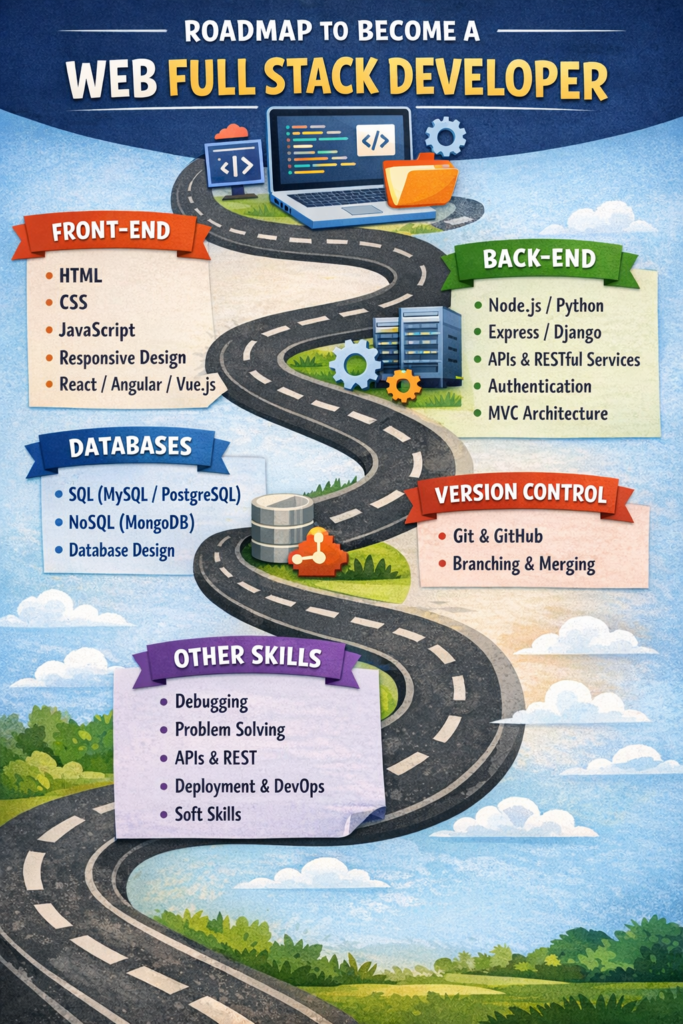
Roadmap to Become a Web Full Stack Developer (2026 Guide)
Introduction
A Full Stack Developer is someone who can build complete web applications — from designing user interfaces to handling databases and servers.
In simple terms:
- Frontend → What users see
- Backend → Logic and server
- Database → Data storage
This guide gives you a clear roadmap, technologies, and stack comparison to help you start from zero and move to professional level.
Prerequisites to Become a Full Stack Developer
Before jumping into frameworks, build a strong base:
Basic Requirements
- HTML, CSS, JavaScript fundamentals
- Basic programming logic
- Understanding of web working (HTTP, browser)
- Version control using Git & GitHub
- Problem-solving mindset
Tip: Don’t skip basics — weak foundation = long-term struggle
Introduction
The demand for Full Stack Developers is increasing rapidly because companies now prefer developers who can build complete applications — from frontend user interfaces to backend systems, APIs, databases, deployment, and cloud infrastructure.
A Full Stack Developer can:
- Design responsive frontend interfaces
- Develop backend business logic
- Work with databases
- Build APIs
- Deploy scalable applications
- Optimize performance and security
This roadmap provides a complete step-by-step guide to becoming a modern Full Stack Web Developer in 2026.
Learn Programming Fundamentals
Before learning frameworks, you must understand programming basics.
– Topics to Learn
- Variables and data types
- Loops and conditions
- Functions
- Arrays and objects
- OOP concepts
- Error handling
- Basic algorithms
– Most Recommended Languages
- JavaScript
- Python
- TypeScript
JavaScript is the most important because it works in both frontend and backend development.
– Master Frontend Development
Frontend development focuses on everything users see and interact with in a web application.
Core Frontend Technologies
HTML5
Used to structure web pages.
CSS3
Used for:
- Styling
- Layouts
- Animations
- Responsive design
JavaScript
Adds:
- Interactivity
- Dynamic content
- Client-side logic
Modern Frontend Frameworks
Most Popular & Highly Used
- React
- Next.js
- Angular
Why These Are Popular?
- Huge job market
- Enterprise support
- SEO optimization
- Fast development
Next.js is now heavily preferred for production-grade applications because of:
- Server-side rendering
- Better SEO
- Performance optimization
Medium Popular Technologies
- Vue.js
- Nuxt.js
- Svelte
- SvelteKit
Least Popular / Declining
- Backbone.js
- Ember.js
- jQuery (mostly legacy projects)
UI Frameworks & Styling Libraries
Most Used
- Tailwind CSS
- Bootstrap
Medium Popular
- Material UI
- Chakra UI
Understand Version Control
Version control helps developers track code changes and collaborate.
Most Popular Tools
- Git
- GitHub
What You Should Learn
- Git clone
- Git commit
- Git push
- Branching
- Pull requests
- Merge conflicts
Learn Server-Side (Backend) Development
Backend development handles:
- Business logic
- Authentication
- Data processing
- APIs
- Security
Most Popular Backend Technologies
- Node.js
- Express.js
- Django
- Laravel
- Spring Boot
Medium Popular Backend Technologies
- Flask
- Ruby on Rails
- FastAPI
Least Popular Backend Technologies
- Perl
- Classic ASP
- ASP.NET Web Forms
Dive Into Databases
Databases store application data permanently.
Most Popular Databases
- MySQL
- MongoDB
- PostgreSQL
Medium Popular Databases
- Firebase
- Redis
Least Popular / Niche Databases
- Cassandra
- CouchDB
Learn API Development
APIs connect frontend and backend systems.
Important Concepts
- REST APIs
- JSON
- Authentication
- JWT tokens
- CRUD operations
Tools Used
- Postman
- Swagger
Mobile & Cross-Platform Development
Modern developers often build mobile apps too.
Most Popular
- React Native
- Flutter
Cloud Deployment & DevOps
Deployment is essential for real-world applications.
Most Used Platforms
- Vercel
- Netlify
- Render
- Amazon Web Services
DevOps Concepts
Learn:
- CI/CD
- Docker
- Nginx
- Linux basics
Learn Modern Architecture
Large applications use scalable architectures.
Important Concepts
- Microservices
- Monolithic architecture
- Serverless computing
- Event-driven systems
System Optimization & Performance
Applications must be fast and scalable.
Learn:
- Caching
- Lazy loading
- CDN
- Database optimization
- Image optimization
Continuously Learn & Improve
Technology changes rapidly.
Keep Learning:
- AI integrations
- Web security
- Cloud-native applications
- Modern frontend frameworks
Most Popular Full Stack Combinations
Most Popular & Highly Used
MERN Stack
MongoDB + Express + React + Node.js
MEAN Stack
MongoDB + Express + Angular + Node.js
LAMP Stack
Linux + Apache + MySQL + PHP
Medium Popular Stacks
- Django Stack
- Spring Boot Stack
- JAMstack
Least Popular Stacks
- Ruby on Rails Stack
- Perl Stack
Best Learning Path for Beginners
Recommended Sequence
- HTML + CSS
- JavaScript
- Git & GitHub
- React
- Next.js
- Backend (Node.js / Django / PHP)
- Database
- APIs
- Deployment
- Projects
Projects You Should Build
Beginner Projects
- Portfolio website
- Calculator
- Blog system
Intermediate Projects
- E-commerce website
- Student management system
- Chat application
Advanced Projects
- SaaS application
- AI-integrated platform
- Video streaming platform
Career Opportunities
After learning Full Stack Development, you can work as:
- Full Stack Developer
- Frontend Developer
- Backend Developer
- DevOps Engineer
- Software Engineer
- Freelance Developer
Salary Expectations (India)
Freshers
₹4 LPA – ₹8 LPA
Mid-Level
₹10 LPA – ₹20 LPA
Experienced
₹25 LPA+
Summary
Full Stack Development is one of the best career choices in 2026 because it combines:
- Frontend development
- Backend systems
- Databases
- Cloud technologies
- DevOps
- Scalability
The best approach is:
– Learn gradually
– Build projects consistently
– Focus on practical implementation
A strong portfolio and real-world projects matter more than certificates.