


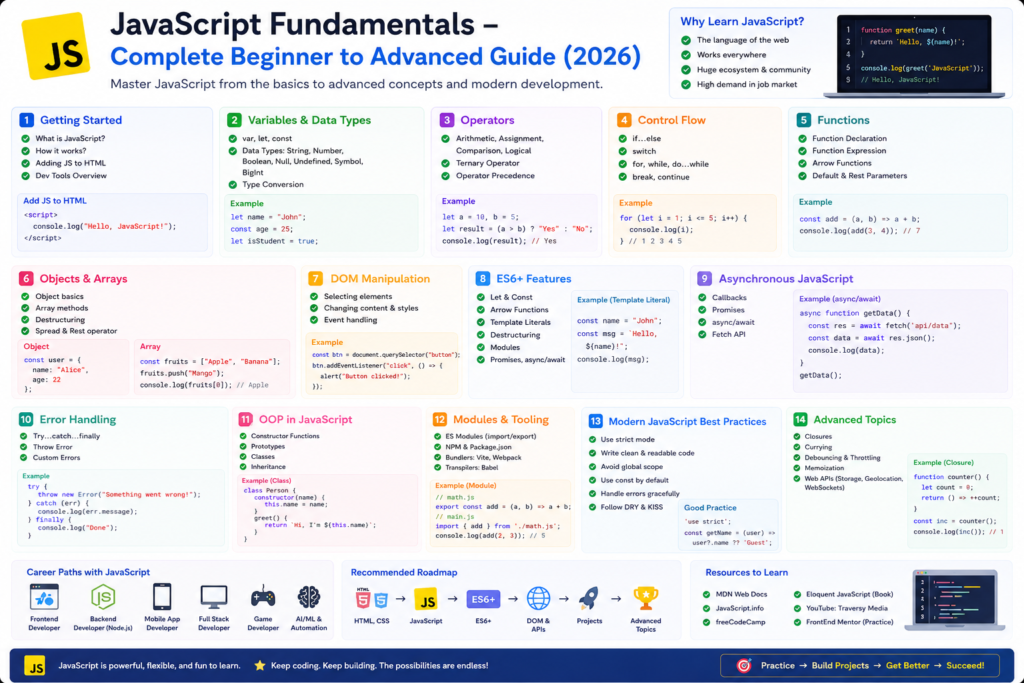
Introduction to JavaScript
JavaScript is one of the most widely used programming languages for web development.
HTML creates the structure of a webpage.
CSS provides styling.
JavaScript adds:
- Interactivity
- User Input Handling
- Dynamic Content Updates
- Form Validation
- Animations
- API Integration
- Real-Time Updates
Without JavaScript, websites would be static and less interactive.
Why Learn JavaScript?
JavaScript powers:
- Websites
- Web Applications
- Mobile Apps
- Desktop Applications
- Games
- APIs
- Server-Side Development using Node.js
Popular platforms built with JavaScript include:
- Netflix
- PayPal
Ways to Add JavaScript
1. Inline JavaScript
<button onclick="alert('Hello World')">
Click Me
</button>
2. Internal JavaScript
<script>

alert("Welcome");

</script>
3. External JavaScript
on index.html
<script src="script.js"></script>alert("External JavaScript");JavaScript Output Methods
alert()
alert("Welcome to JavaScript");console.log()
console.log("Hello Developers");document.write()
document.write("Hello World");Variables in JavaScript
Variables store data values.
Using var
var name = "Akshay";Using let
let age = 25;Using const
const PI = 3.14159;| Feature | var | let | const |
|---|---|---|---|
| Redeclare | Yes | No | No |
| Reassign | Yes | Yes | No |
| Scope | Function | Block | Block |
JavaScript Data Types
String
let name = "Akshay";Number
let marks = 85;Boolean
let status = true;Undefined
let city;Null
let value = null;Array
let subjects = ["HTML","CSS","JavaScript"];Object
let student = {
name:"Akshay",
age:25
};
Operators in JavaScript
Arithmetic Operators
let a = 10;
let b = 5;

console.log(a+b);
console.log(a-b);
console.log(a*b);
console.log(a/b);
console.log(a%b);
Comparison Operators
console.log(10>5);
console.log(10<5);
console.log(10==5);
console.log(10!=5);
Logical Operators
let x = true;
let y = false;

console.log(x && y);
console.log(x || y);
console.log(!x);
User Input
Using prompt()
let name = prompt("Enter Your Name");

alert(name);
Conditional Statements
if Statement
let age = 18;

if(age>=18){
alert("Eligible");
}
if else
let marks = 40;

if(marks>=35){
console.log("Pass");
}
else{
console.log("Fail");
}
else if Ladder
let marks = 75;

if(marks>=80){
console.log("A Grade");
}
else if(marks>=60){
console.log("B Grade");
}
else{
console.log("C Grade");
}
Switch Statement
let day = 2;

switch(day){

case 1:
console.log("Monday");
break;

case 2:
console.log("Tuesday");
break;

default:
console.log("Invalid Day");

}
Loops in JavaScript
for Loop
for(let i=1;i<=5;i++){
console.log(i);
}
while Loop
let i=1;

while(i<=5){

console.log(i);

i++;

}
do while Loop
let i=1;

do{

console.log(i);

i++;

}
while(i<=5);
Functions
Functions are reusable blocks of code.
Simple Function
function welcome(){

alert("Welcome");

}

welcome();
Function with Parameters
function add(a,b){

return a+b;

}

console.log(add(10,20));
Arrays
Arrays store multiple values.
let colors = ["Red","Green","Blue"];

console.log(colors[0]);
Array Methods
colors.push("Yellow");

colors.pop();

colors.shift();

colors.unshift("Black");
Objects
Objects store data as key-value pairs.
let student = {

name:"Akshay",

age:25,

course:"Web Design"

};

console.log(student.name);
String Methods
let name = "JavaScript";

console.log(name.length);

console.log(name.toUpperCase());

console.log(name.toLowerCase());
Math Object
console.log(Math.PI);

console.log(Math.sqrt(25));

console.log(Math.random());
Date Object
let today = new Date();

console.log(today);
DOM (Document Object Model)
The DOM allows JavaScript to access and modify HTML elements.
The Document Object Model (DOM) is a programming interface that represents an HTML (or XML) document as a hierarchical tree of nodes, where each tag, text, and attribute becomes an object that scripts can read and modify. JavaScript interacts with this tree to dynamically change structure, style, and content, enabling rich, interactive web applications.
What is the DOM?
- The DOM treats the entire webpage as a tree starting from a root document node, with elements like <html>, <head>, and <body> as children.
- Every element (<div>, <p>, <a>), text node, and attribute can be accessed and manipulated via JavaScript, allowing scripts to add, remove, or modify parts of the page.
- The DOM is language-independent: JavaScript is most common in browsers, but the model itself is defined so that different languages could use it.
Why DOM manipulation matters
- Interactivity: Enables dynamic behaviors such as dropdown menus, tabs, modals, form validation feedback, and interactive dashboards.
- Real-time updates: Content can be updated without a full page reload (e.g., updating a cart count, chat messages, live scores), improving perceived performance.
- Partial updates instead of reloads: Combined with AJAX / fetch, only specific sections of the DOM are updated, reducing bandwidth usage and server load.
- Enhanced UX: Smooth transitions, inline form validation, live search suggestions, and conditional UI states all rely on DOM manipulation.
Core DOM access and modification methods
- Selecting elements
- document.getElementById(id)
– Returns the element whose id matches the given string (fast, unique).
-
- document.getElementsByClassName(className)
– Returns an HTMLCollection of elements with a given class.
-
- document.getElementsByTagName(tagName)
– Returns elements by tag name (e.g., “p”, “button”).
-
- document.querySelector(selector)
– Returns the first element matching a CSS selector (e.g., “.btn.primary”, “#loginForm”).
-
- document.querySelectorAll(selector)
– Returns a static NodeList of all elements matching a CSS selector.
- Reading and updating content
- element.innerHTML – Gets/sets HTML markup inside an element (can insert nested tags).
- element.innerText / element.textContent – Gets/sets plain text content.
- element.value – Reads or changes the value of form fields (<input>, <textarea>, <select>).
- Styling and attributes
- element.style.propertyName – Applies inline styles (e.g., element.style.color = “red”;).
- element.classList.add(), .remove(), .toggle() – Adds/removes CSS classes, preferred over editing style directly.
- element.setAttribute(name, value) / getAttribute(name) – Manages attributes like src, href, alt, data-*.
- Creating and removing elements
- document.createElement(“div”) – Creates a new element node.
- parent.appendChild(child) / parent.prepend(child) – Inserts elements into the DOM tree.
- parent.removeChild(child) or element.remove() – Removes elements from the DOM.
Selecting Elements
document.getElementById("title");document.querySelector(".box");Changing Content
document.getElementById("title")
.innerHTML="Welcome";
Changing CSS
document.getElementById("title")
.style.color="red";
Event Handling
Events occur when users interact with a webpage.
Button Click Event
<button onclick="showMessage()">
Click Me
</button>
function showMessage(){
alert("Button Clicked");
}Mouse Event
element.addEventListener(
"mouseover",
function(){

alert("Mouse Over");

});
Form Validation Example
<input type="text" id="username">

<button onclick="validate()">
Submit
</button>
function validate(){
let user =
document.getElementById("username").value;
if(user==""){
alert("Username Required");
}
}ECMAScript 6 (ES6) – Modern JavaScript
What is ES6?
ES6 (ECMAScript 2015) is a major update to JavaScript that introduced many powerful features, making code cleaner, shorter, and easier to maintain.
Before ES6, developers primarily used var and traditional functions. ES6 introduced features like:
- let and const
- Arrow Functions
- Template Literals
- Destructuring
- Spread Operator
- Rest Parameters
- Classes
- Modules
- Promises
Today, almost all modern JavaScript applications use ES6+ syntax.
Why Was ES6 Introduced?
ES6 was introduced to:
- Reduce code complexity
- Improve readability
- Support modern application development
- Make JavaScript more powerful
- Simplify asynchronous programming
let and const
Before ES6:
var name = "Akshay";ES6 introduced:
let name = "Akshay";
const PI = 3.14159;
Difference
| Keyword | Can Reassign | Can Redeclare |
|---|---|---|
| var | Yes | Yes |
| let | Yes | No |
| const | No | No |
Template Literals
Before ES6:
let name = "Akshay";

console.log("Welcome " + name);
Using ES6:
let name = "Akshay";

console.log(`Welcome ${name}`);
Benefits:
- Cleaner syntax
- Easier string formatting
- Supports multiline strings
Arrow Functions
Traditional Function:
function add(a,b){
    return a+b;
}
ES6 Arrow Function:
const add = (a,b) => a+b;

console.log(add(10,20));
Benefits:
- Shorter syntax
- Cleaner code
- Widely used in React and modern JavaScript
Destructuring
Extract values from arrays or objects easily.
Array Destructuring
const colors = ["Red","Green","Blue"];

const [first, second] = colors;

console.log(first);
Object Destructuring
const student = {
    name:"Akshay",
    age:25
};

const {name, age} = student;

console.log(name);
Spread Operator (…)
The spread operator expands arrays or objects.
const numbers1 = [1,2,3];

const numbers2 = [...numbers1,4,5];

console.log(numbers2);
Output:
[1,2,3,4,5]Rest Parameters
Collect multiple values into one parameter.
function total(...numbers){

    let sum = 0;

    for(let num of numbers){
        sum += num;
    }

    return sum;
}

console.log(total(10,20,30));
Classes in ES6
ES6 introduced Object-Oriented Programming syntax.
class Student{

    constructor(name){

        this.name = name;
    }

    display(){

        console.log(this.name);
    }

}

const s1 = new Student("Akshay");

s1.display();
JavaScript Modules
Modules help organize code into separate files.
math.js
export function add(a,b){

    return a+b;

}
app.js
import {add} from './math.js';

console.log(add(10,20));
Benefits of ES6
- Cleaner syntax
- Improved readability
- Better performance
- Easier maintenance
- Industry standard
- Essential for React, Node.js, and Next.js
JSON (JavaScript Object Notation)
What is JSON?
JSON stands for JavaScript Object Notation.
It is a lightweight format used for storing and exchanging data between:
- Browser and Server
- APIs and Applications
- Frontend and Backend Systems
JSON is one of the most widely used data formats on the internet.
Why JSON is Important?
JSON is used in:
- REST APIs
- AJAX Requests
- Web Services
- Database Applications
- Mobile Applications
Whenever data travels between a server and a browser, JSON is commonly used.
JSON Structure
JSON stores data as key-value pairs.
Example:
{
    "name":"Akshay",
    "age":25,
    "city":"Nashik"
}
JavaScript Object vs JSON
JavaScript Object
const student = {

    name:"Akshay",
    age:25

};{
"name":"Akshay",
"age":25
}Difference
| JavaScript Object | JSON |
|---|---|
| Keys may be unquoted | Keys must be quoted |
| Used in JavaScript code | Used for data exchange |
| Supports functions | Does not support functions |
Converting Object to JSON
JSON.stringify()
const student = {

    name:"Akshay",
    age:25

};

const jsonData =
JSON.stringify(student);

console.log(jsonData);
Output:
{"name":"Akshay","age":25}Converting JSON to Object
JSON.parse()
const jsonData =
'{"name":"Akshay","age":25}';

const student =
JSON.parse(jsonData);

console.log(student.name);
Output:
AkshayJSON Array Example
[
    {
        "name":"Akshay",
        "course":"Web Design"
    },
    {
        "name":"Rahul",
        "course":"JavaScript"
    }
]
Real-World JSON Example
Data returned by an API:
{
    "id":101,
    "product":"Laptop",
    "price":45000,
    "stock":true
}
JavaScript can read this JSON and display it on a webpage dynamically.
ES6 and JSON in Modern Development
Modern technologies heavily depend on ES6 and JSON:
| Technology | Uses ES6 | Uses JSON |
|---|---|---|
| React | ✔ | ✔ |
| Next.js | ✔ | ✔ |
| Node.js | ✔ | ✔ |
| Express.js | ✔ | ✔ |
| REST APIs | ✔ | ✔ |
| MongoDB Applications | ✔ | ✔ |
Error Handling
try{
let x=10/0;
}
catch(error){
console.log(error);
}
Timers
setTimeout()
setTimeout(function(){

alert("Hello");

},3000);
setInterval()
setInterval(function(){
console.log("Running");
},1000);
Complete JavaScript Project Example
Build a Student Grade Calculator using:
- Variables
- Operators
- Functions
- DOM
- Events
<!DOCTYPE html>
<html>
<head>
<title>Grade Calculator</title>
</head>
<body>
<h1>Grade Calculator</h1>
<input type=”number” id=”marks”>
<button onclick=”calculateGrade()”>
Calculate
</button>
<h2 id=”result”></h2>
<script>
function calculateGrade(){
let marks =
document.getElementById(“marks”).value;
let grade=””;
if(marks>=80){
grade=”A”;
}
else if(marks>=60){
grade=”B”;
}
else if(marks>=35){
grade=”C”;
}
else{
grade=”Fail”;
}
document.getElementById(“result”)
.innerHTML=”Grade : “+grade;
}
</script>
</body>
</html>
Common Interview Questions
What is JavaScript?
Difference between var, let and const?
What are JavaScript Data Types?
What is DOM?
Difference between == and ===?
What are Arrow Functions?
What is Event Handling?
What is JSON?
What is Hoisting?
What is Closure?
Best Practices
- Use
letandconstinstead ofvar - Keep functions small and reusable
- Validate user input
- Avoid global variables
- Use external JavaScript files
- Follow ES6+ standards